
Haltom City Previous Residents by Era
Start the past-residents trail at the time period, then select a source that can actually reach it. Ownership evidence and household evidence should remain in separate columns of a research note. The county's current official-records portal displays a certification-through date but does not state a complete online start year. The regional directory holdings are valuable, yet a complete Haltom-specific reverse-directory run was not located in official sources.
| Source | Years or status | Where held | What it can establish |
|---|---|---|---|
| TAD parcel card | Current tax years; historical online start not stated | Tarrant Appraisal District | Current owner, property and mailing fields, legal description, values |
| Official-records index | Current portal; start year not stated | Tarrant County Clerk | Recorded deeds, liens, releases, plats, and party roles |
| Deed-history cards | 1876–1984 | Tarrant County property-tax/archive route | Bridge from a current parcel to older ownership research |
| Archives property material | Deed-index evidence 1876–1920; property ledgers 1876–1917 | Tarrant County Archives | Older grantor/grantee and property leads; handwriting may not search well |
| Directories and census | Regional directory runs not fully stated; federal census through 1950 | Fort Worth History Center, archives, NARA, library routes | Dated address or household evidence, subject to omissions |
For a recent property event, begin with TAD and the Clerk. For an older address, deed-history cards and the archives may be the bridge. A date on a source is part of the answer, not a minor detail.
Trace Haltom City Owners Backward
The deed chain begins with a current parcel record instead of a broad name search. Save the TAD account number, geo reference, property address, owner name, primary owner address, subdivision, block and lot, legal description, and any instrument reference. Next, search the current owner as a grantee in the County Clerk's Real Property department. The purchase deed can identify the seller, earlier instrument reference, legal description, and recording date.
- Locate the current parcel card and preserve the physical address and legal description separately from the mailing field.
- Search the apparent current owner as grantee, then open the likely purchase instrument.
- Record grantor, grantee, document type, recording date, document number, legal description, and prior reference.
- Search the seller as a prior grantee to identify that person's acquisition, then repeat one conveyance at a time.
- When the online trail stops, test deed-history cards, archives indexes, and clerk copy routes rather than assuming the property had no earlier record.
- Grantor and grantee
- The grantor transfers an interest; the grantee receives it. Record both roles instead of treating every indexed name as an owner.
- Chain of title
- A sequence of recorded ownership instruments for the same legal parcel. It is not a continuous list of occupants.
- Legal description
- The subdivision, block, lot, or other parcel wording used in an instrument. It usually outlasts a changed street number.
Read Tarrant County Recorded Instruments
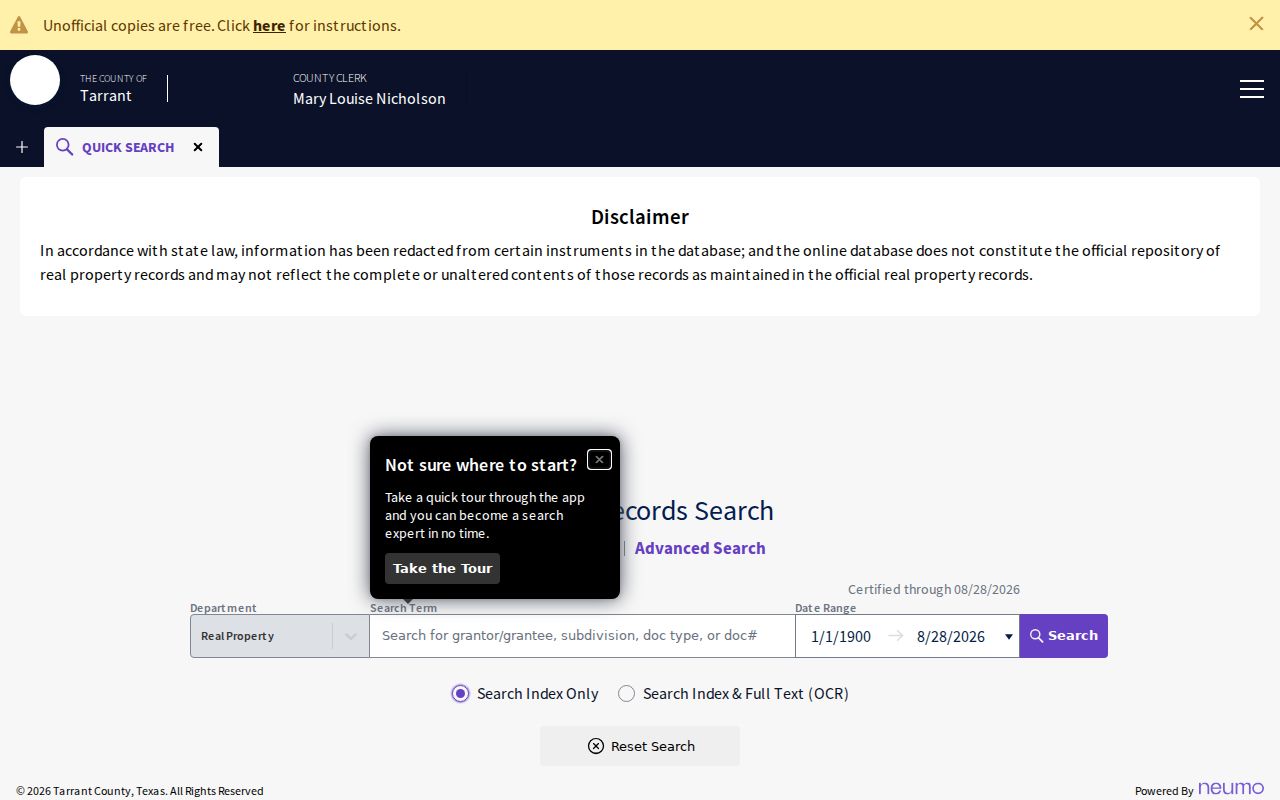
The Clerk's portal offers Quick Search and Advanced Search with a Real Property department, search term, date range, date shortcuts, and index-only or index-and-full-text options. Search modes include grantor/grantee, subdivision, document type, and document number. Document categories include deeds, deeds of trust, easements, plats, liens, releases, probate material, assignments, mineral deeds, affidavits of heirship, and notices. They are not interchangeable.
The Tarrant County Clerk real-property search capture below is the official starting interface for the indexed instrument trail.
A deed of trust is financing evidence, not an automatic transfer. A release changes a lien record. A plat describes the layout of lots and streets. The Clerk does not conduct title or lien searches, so a chain assembled from index results must be described as records research rather than a title opinion.
Bridge Haltom City Archive Gaps
The official deed-history-card resource covers 1876 through 1984 and can connect a modern parcel to older records. Tarrant County Archives also identifies deed-index evidence for 1876 through 1920 and historic property ledgers for 1876 through 1917. These are leads with different access states, not one seamless online database. Handwritten pages may not have usable OCR, so a failed text search needs a visual review or staff-assisted path before it is treated as absent.
Pre-1876 work carries a separate warning. The city history and archives describe losses of early loose papers in the March 29, 1876 courthouse fire. Later deeds, commissioners-court volumes, direct and reverse indexes, or certified copies may preserve part of the trail. A gap belongs in the final timeline. It should never be quietly bridged with a similar name.
The local jurisdiction label can also change without the physical site changing. Haltom Village was founded in 1932, and the city history describes later consolidation with Oak Knoll and annexations. Research an older parcel under Birdville, Haltom Village, Oak Knoll, Fort Worth, and relevant neighboring labels when the modern address does not appear. Preserve the historic name in a citation, then add the modern parcel connection only when the maps, legal description, or cross streets support it.
Match Previous Residents to Dated Directories
Past residents require a second evidence track after the ownership chain. A criss-cross directory, when available, is arranged by address and can connect an address to a dated entry. An alphabetical directory may provide a cross-reference, business notation, or abbreviated household listing. Neither turns an address listing into proof of legal residence. It is best described as an address-at-publication lead and checked against an edition date, the page, and the directory's abbreviation key.
- Normalize the street name, suffix, old highway name, spelling variants, and historic place label.
- Search the address in a reverse or criss-cross directory, then use the alphabetical entry to test the name and notation.
- Move backward edition by edition, noting every gap, renumbering possibility, and change in address format.
- Pair a directory year with the nearest available federal census, school census, obituary, probate abstract, or newspaper lead.
Tarrant County Archives holds school census material from 1919 through 1970 and early probate abstracts from 1866 through 1959. The Fort Worth History Center describes 9,500 microfilm rolls, primarily census and city directories. The collections are regional, so request the exact run and do not assume a Haltom entry exists in every volume.
Place Previous Residents on Historic Maps
Maps test whether an older address and a current parcel describe the same physical place. The Tarrant Archives Thompson collection includes Sanborn Volume 7 for Haltom City and neighboring Richland Hills. Its dated material includes a February 1949 key, a February 1950 index, and corrections from March 1956 and March 1958. A Sanborn sheet can show a building footprint, use, construction clues, street orientation, and neighboring structures. It is not a resident list.
The Tarrant County Archives maps and plans collection is represented by the capture below.
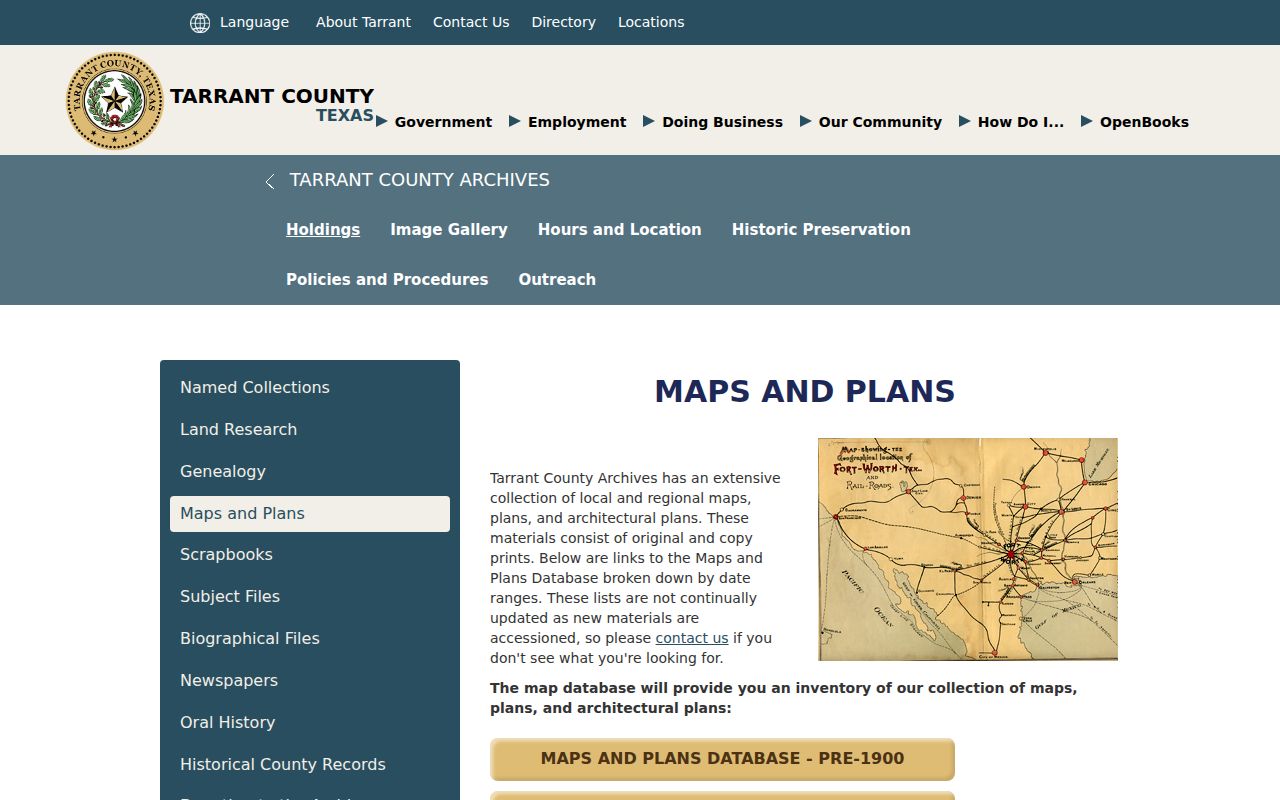
No official year-specific street-renumbering register was located. When a number fails, compare cross streets, subdivision and lot data, the legal description, directory neighbors, and the building footprint. Older records may use Birdville, Haltom Village, or Oak Knoll rather than the modern municipal label.
Use Haltom City Archive Leads Carefully
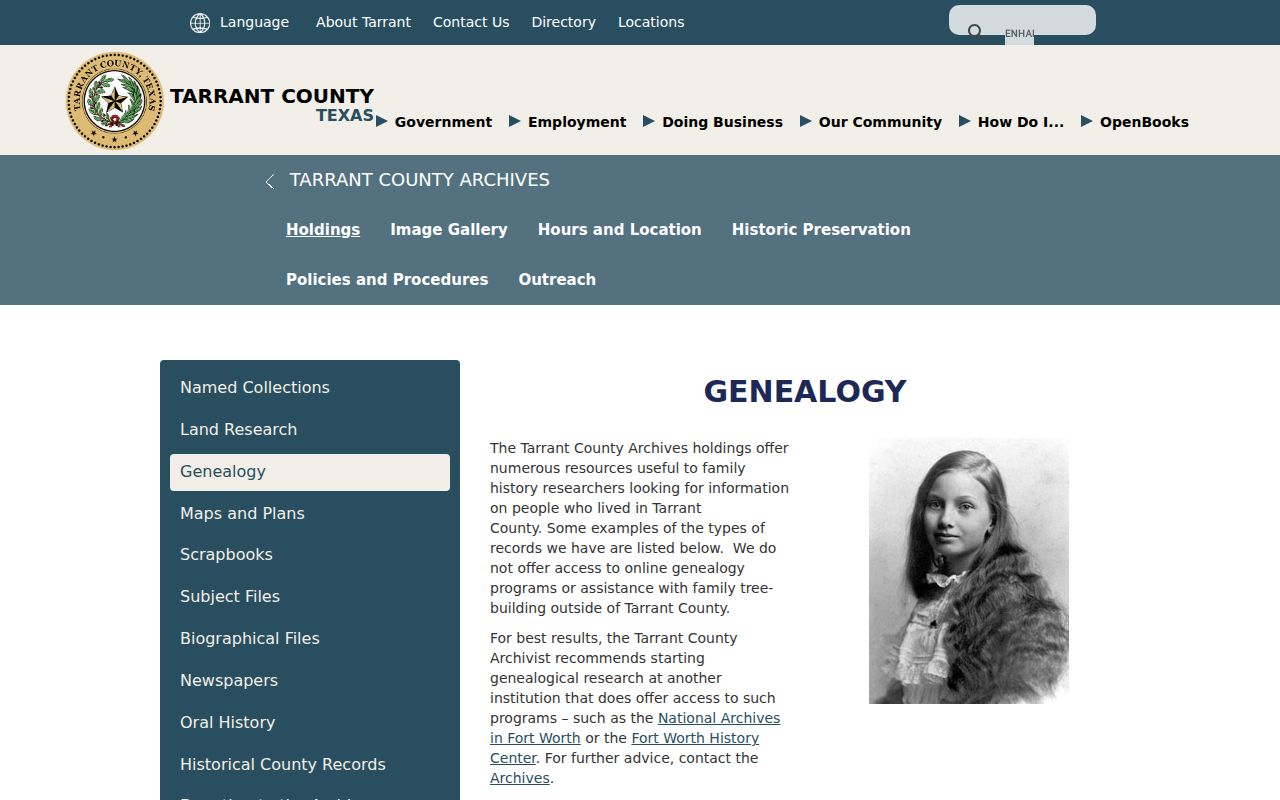
The Haltom Public Library's genealogy and history resources point toward Sanborn maps, HeritageQuest, Tarrant vital-record routes, TSLAC, UNT, FamilySearch, and local history research. Tarrant Archives lists historic maps and city directories, school census, cemetery records, title abstracts, and genealogy material. Its public hours are Tuesday through Friday, with Monday by appointment. A dedicated local house-history guide or service was not located in the reviewed official sources.
The Tarrant County Archives genealogy holdings capture shows the county collection route for directory, map, and genealogy research.
Obituaries, cemetery records, and probate can help close a dated interval, but each has its own limits. An obituary is a family-published source. A cemetery discovery entry is not automatically an official interment register. Probate may identify an estate but not a complete household. Record the source type and date with every past-resident conclusion.
Federal census material is released under the 72-year rule, with 1950 as the most recent publicly available decennial census. It can add a household and geographic clue, but street numbers do not survive in every schedule. The archive school census series, directories, county records, and maps may supply the missing address link. Keep the census enumeration, directory publication, and deed recording dates separate. They document different events at different moments.
Haltom City Previous Residents Limits
One address can produce different roles: recorded owner, mailing recipient, grantor, grantee, trustee, beneficiary, permit applicant, directory entry, or person named in an obituary. Those roles cannot be collapsed into one label. A prior owner may have allowed another household to use the property, while a past address listing may describe a business or boarding arrangement. State the narrowest support: “owner during the recorded interval” or “address listing in the directory year.”
Use the same caution when a name repeats. Search the instrument number, legal description, cross streets, and date before linking records. If the evidence does not connect a person to the parcel, leave the relationship unresolved. The record trail remains useful even when its final conclusion is an explicit gap.
Lawful use. Haltom City past-residents research is for house history, family history, and personal records work. Do not use old records to track, threaten, harass, or harm a living person. Texas Penal Code sections 42.07 and 42.072 address harassment and stalking.